The Difference Between Cloud RO and Traditional Water Filters
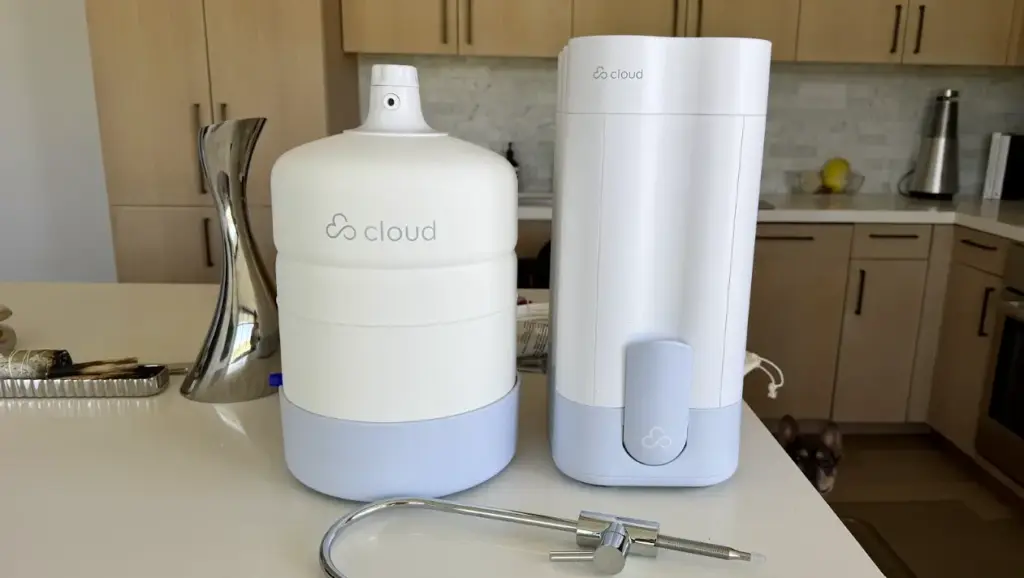

Most of us assume that if our tap water tastes clean – and we’ve run it through a pitcher filter – it’s safe to drink. But taste and purity aren’t the same thing.
A cleaner taste doesn’t necessarily mean cleaner water. While pitcher filters can reduce chlorine and improve flavor, contaminants like PFAS (“forever chemicals”), heavy metals, pharmaceuticals, and dissolved solids may still pass through.
1 in 5
Americans may have a dangerous toxin
in their tap water.
Source: CNN Health, April 2026
That’s one reason more homeowners are looking beyond basic carbon filtration and choosing reverse osmosis systems like Cloud RO – which removes up to 99% of contaminants while adding essential minerals back into the water.
Why Pitcher Filters Like Brita Aren’t Enough
LIMITATION 01
Focuses on improving taste only
Pitcher filters primarily reduce chlorine and odor to improve taste, but better-tasting water doesn’t necessarily mean cleaner water.
LIMITATION 02
Doesn’t address PFAS and many other contaminants
Basic carbon filtration is not designed to consistently reduce contaminants such as PFAS, fluoride, pharmaceuticals, and many dissolved heavy metals.
LIMITATION 03
Effectiveness reduces over time
As activated carbon becomes saturated, filtration performance gradually declines until the filter cartridge is replaced.
Better taste often creates a false sense of deeper purification, even when the underlying filtration is still limited to a narrow range of contaminants.
The Numbers Behind The Cloud RO
15×
Cloud RO removes up to 15× more contaminants than leading pitcher filters.
98%
Total Dissolved Solids (TDS) rejection rate.
0.0001 µm
RO membrane pore size used to separate dissolved contaminants from water.
Why More Homeowners Are Choosing Reverse Osmosis
Reverse osmosis is widely regarded as one of the most comprehensive forms of residential water filtration because it targets a broad spectrum of dissolved contaminants at the molecular level.
Across industry-standard testing frameworks, RO systems typically achieve:
- ~95–99% reduction of total dissolved solids (TDS)
- High reduction of heavy metals such as lead and copper
- Significant reduction of contaminants like fluoride, PFAS, pesticides, and pharmaceuticals (system-dependent and certification-based)
Cloud RO reports a 98% TDS rejection rate and has been third-party tested to NSF standards including NSF 42, 53, 58, and 401 – with NSF 58 certification specifically for reverse osmosis performance.
Water Quality Comparison
Targeted contaminant filtration analysis: Tap Water vs. Cloud RO Purified Water
💧 TAP WATER (UNTREATED)
Arsenic
Heavy Metals
0.00061 ppm
Lead
Heavy Metals
0.00024 ppm
Lithium
Metals / Minerals
0.01 ppm
Antimony
Heavy Metals
0.0042 ppm
Nitrates
Inorganics / Fertilizers
2.36 ppm
Fluoride
Inorganics / Minerals
0.2 ppm
Disinfectant Byproducts
Total Trihalomethanes (TTHMs)
14.7 ppb
🌱 CLOUD RO PURIFIED WATER
Arsenic
Heavy Metals
Not Detected
Lead
Heavy Metals
Not Detected
Lithium
Metals / Minerals
Not Detected
Antimony
Heavy Metals
Not Detected
Nitrates
Inorganics / Fertilizers
Not Detected
Fluoride
Inorganics / Minerals
Not Detected
Disinfectant Byproducts
Total Trihalomethanes (TTHMs)
Not Detected
✓ Cloud Reverse Osmosis filtration successfully reduced all targeted contaminants down to undetected laboratory levels.
What Sets Cloud RO Apart
Cloud RO is a full reverse osmosis system designed for residential use, with a focus on usability, consistency, and everyday performance.
Key features include:
- Eight-stage filtration process
- 2.8-gallon storage tank for instant access
- Battery-powered operation (no outlet required under sink)
- Smart app monitoring for filter life and system performance
- Compatibility with refrigerators and ice makers
- NSF 58 certification and third-party tested standards compliance
Unlike basic filtration systems, Cloud RO is built around the full reverse osmosis process – but optimized for daily use in a home environment where convenience and consistency matter as much as filtration performance.
Feature |
Cloud RO |
Typical Tankless RO |
|---|---|---|
| Comprehensive RO filtration | ✓ | ✓ |
| Reduces a broad range of dissolved contaminants | ✓ | ✓ |
| Remineralizes purified water | ✓ | Varies |
| Smart filter monitoring | ✓ | Varies |
| Instant filtered water | ✓ (2.8-gallon tank) | On-demand |
| Requires electrical outlet | X | Usually ✓ |
| Connects to fridge & ice maker | ✓ | Varies |
| Third-party certified | NSF 58 + NSF 42, 53, 58 & 401 testing | Model dependent |
What This Actually Means in Practice
When people switch from pitcher filters to reverse osmosis, the most noticeable changes tend to be:
- more consistent water taste
- less dependence on filter “timing” assumptions
- broader reduction of dissolved contaminants
Compared to tankless RO systems like Waterdrop G3P800, tank-based RO systems like Cloud RO can also provide more stable taste and mineral balance due to stored, post-filtered water.
For most households, the shift isn’t just upgrading a filter – it’s changing what “clean water” actually means.
Love this system. Water tastes great. Easy install, water quality monitoring and auto filter shipping only when actually needing to be replaced. Well worth the purchase.
— Adam T
Final Thoughts
Most people think about water filtration in technical terms – taste, convenience, and habit.
Pitcher filters like Brita feel familiar because they improve taste, but they only deliver surface-level filtration.
Reverse osmosis works differently. It doesn’t just improve water – it strips out a far broader range of contaminants at the source, changing what’s actually in your water. Cloud RO is built on that level of filtration, not cosmetic improvement.
Start Thinking About Your Water Filter Like You Think About Your Air Filter
More homeowners are moving beyond basic pitcher filters and choosing reverse osmosis systems designed to reduce a broader range of contaminants while delivering clean, great-tasting water every day.
Explore the Cloud RO Reverse Osmosis System →*https://edition.cnn.com/2026/04/23/health/nitrates-tap-water-toxin-wellness