Casper Vs. Nectar Vs. Helix: Which Kids’ Mattress Actually Earns Its Price Tag?
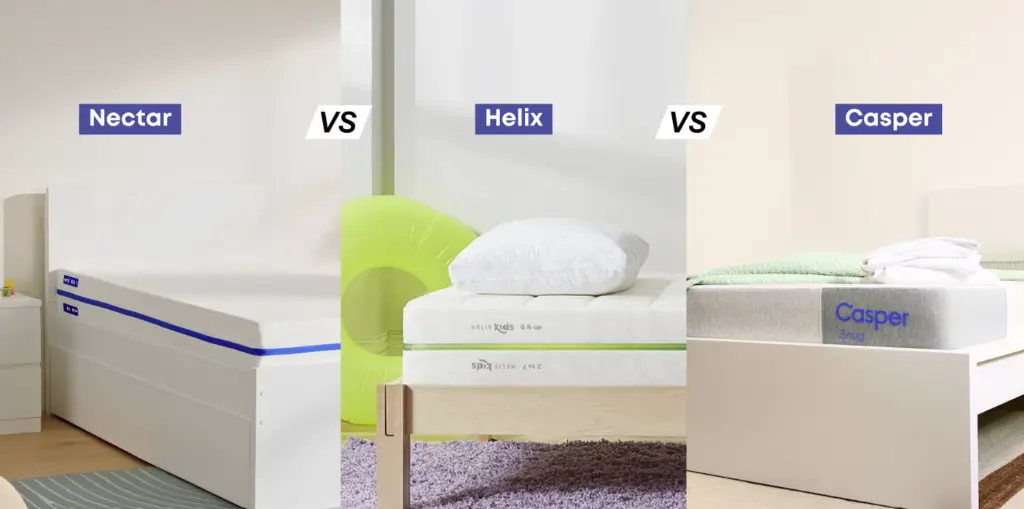

Somewhere between the toddler bed and the teenage years, every parent hits the same wall: your kid needs a real mattress. Suddenly, you’re staring down a dozen “kids’ mattress” ads that promise the same thing: growing bodies, better sleep, easy cleanup. The pitch is identical, the mattresses, it turns out, are not. And the differences show up at 2 am, not on the spec sheet.
We looked closely at three of the most talked-about bed-in-a-box options built specifically for kids – Casper Snug™, Nectar Kids, and Helix Kids – to see which one actually backs up the marketing claims.
Key Similarities
- All three are purpose-built for the twin and full sizes kids actually need; none of them require a box spring
- Each one uses CertiPUR-US-certified foam, so you’re not introducing anything you wouldn’t want in a kid’s room.
- Every option also ships free, comes compressed in a box for easy setup, and includes a trial period long enough to actually test it through a few weeks of real bedtime – not just decide on day two when everything still smells new.
Key Differences
Best Kids Mattress Picks
✓ Medium-firm feel, no flipping needed
✓ Two comfort layers
✓ Includes 2 waterproof mattress protectors
✓ CertiPUR-US Certified, free from harmful chemicals
✓ Designed and assembled in the USA
✓ Flippable dual firmness
✓ CertiPUR-US Certified, free from harmful chemicals
✕ Only one comfort layer
✕ Ships with one washable cover – no waterproof protector included
✓ Flippable dual firmness
✓ Two comfort layers
✓ CertiPUR-US Certified, free from harmful chemicals
✓ Hybrid coil-and-foam build
✕ No mattress protector included
Casper Snug™ Overview
The Snug™ is built from four layers, each doing specific work. A buttery soft knit Cozy Cover makes bedtime feel like bedtime. Beneath it, Breathe Flex Foam (an open-cell, responsive foam) keeps air moving and prevents that stuck, overheated feeling that wakes kids up at 3 am.
A Soothe Memory Foam middle layer then gently cradles them into deeper sleep, while the dense Casper Core base keeps the whole thing from sagging as your kid grows. At 8 inches tall, it’s low enough for little ones to get in and out on their own and slim enough to work in a bunk bed.
What sets it apart is what’s already in the box. Two five-sided waterproof protectors come standard – which matters more than it sounds like at 2 am during a stomach bug or a forgotten cup of juice. Buying that same protection separately for another mattress typically runs well over $100, so the math on Casper’s price tag looks a lot better once you factor in what’s included.
Nectar Kids Overview
At $349 for a twin, Nectar looks like the budget pick – until you do the math. The flippable design pairs a cradling support layer for ages 3-7 with a gel memory foam layer for ages 8-12, each sitting on the same 3-inch durable foundation.
But here’s where the budget constraints show: each side relies on just one comfort layer to do the work. Independent testing found contributes to below-average pressure relief scores. For a mattress marketed at growing bodies, pressure relief is important.
Then there’s protection: no waterproof protector is included, and Nectar’s own protectors start at $99 each. Add that to the sticker price, and you’re looking at $448 or more before your kid has slept on it – for a mattress that still underperforms on comfort.
Helix Kids Overview
Helix takes the only hybrid approach here, pairing a five-inch pocketed steel coil base with foam comfort layers on each side of its flippable design. The firmer side (ages 3-7) uses Helix Responsive Foam for spinal support, while the softer side (ages 8+) layers in Gel Memory Foam for cushioning. The TENCEL™ cover is breathable and hypoallergenic.
But if you want the cooling performance Helix really markets (the GlacioTex upgrade that addresses heat retention), the price jumps significantly. The base twin starts at $599 on sale, but the GlacioTex version runs $705+, before you’ve added the $59 protector you’ll still need.
That puts you at $764 or more for a kids’ mattress. For most families, paying a premium for cooling that comes standard elsewhere is hard to justify.
Final Thoughts
All three mattresses are legitimate upgrades over a hand-me-down spring set, but for the best overall value, we recommend the Casper Snug™.
Nectar’s $349 twin looks appealing until you add the protector you’ll need, bringing the real cost to $448 or more. And despite the similar price, independent testing found it scores below average on pressure relief due to its single comfort layer.
The base twin from Helix starts at $599 before a protector, and the GlacioTex cooling upgrade costs $705 – and that’s with a 20% discount. Casper’s Breathe Flex Foam layer includes cooling airflow by default.
At $499, Casper Snug™ includes everything: two waterproof protectors, two comfort layers, built-in cooling, and a medium-firm feel that works from ages 3 to 12 without ever needing to flip. One purchase, one setup, one mattress that grows with your kid.
Backed by a 10-year limited warranty, a 100-night trial, and a 92% customer keep rate, it’s the option most families won’t need to revisit. There’s rarely been a better time to make the switch.